

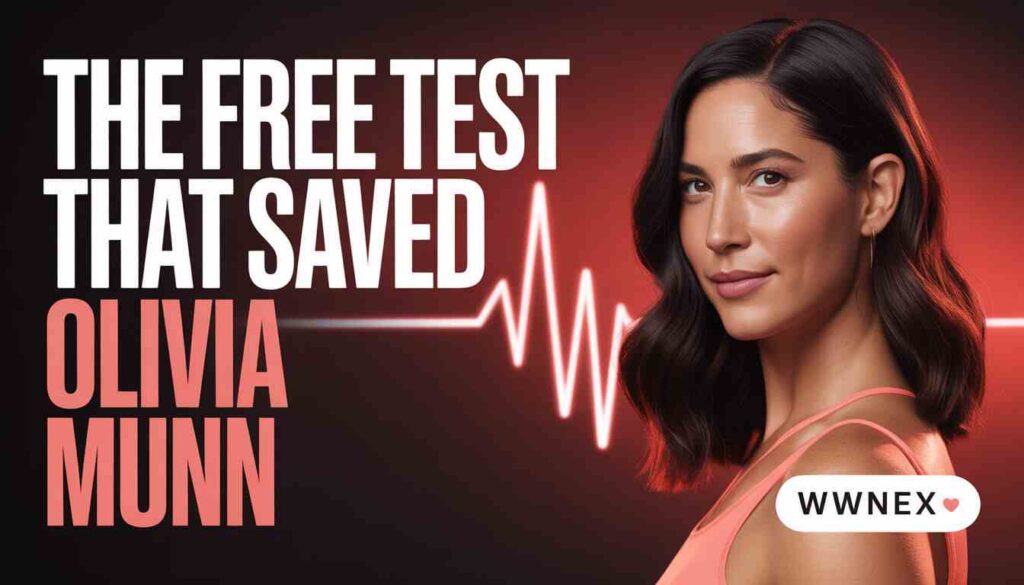
Discover how a free online test saved Olivia Munn from “silent” breast cancer. Learn about the BCRAT, early detection, and John Mulaney’s vital caregiver role.
🛑 The Shocking 2026 Reality of “Silent” Breast Cancer
Did you know that after a single celebrity revealed her “silent” breast cancer diagnosis, the National Cancer Institute reported a 4,000% increase in women taking early-detection risk assessments?
When actress Olivia Munn revealed the harrowing details of her Stage 1 bilateral breast cancer diagnosis, the world was stunned. She had zero symptoms. Her mammograms were completely clear. Yet, beneath the surface, an aggressive, fast-moving cancer was taking hold.Her husband, comedian John Mulaney, stood by her side during a taxing ordeal of surgeries, including a hysterectomy and double mastectomy.
In 2026, as Munn celebrates being cancer-free and welcomes a new chapter with Mulaney and their children, her story is no longer just Hollywood news. It is a critical, lifesaving framework for early detection. Why does this matter to you today? Because the exact free tool that saved her life is available right now.
In this comprehensive guide, we will break down Olivia Munn’s challenging yet “lucky” journey, explore the crucial caregiver role John Mulaney played, and provide you with the exact medical frameworks and tools you need to assess your own health risk in 2026.
🔬 What is the Breast Cancer Risk Assessment Tool?
Snippet Answer >The Breast Cancer Risk Assessment Tool (BCRAT) is a free, clinically validated online survey that frequently makes use of the Tyrer-Cuzick Risk Model. By examining age, family history, genetics, and reproductive history, it determines a woman’s five-year and lifetime risk of having invasive breast cancer. A score of more than 20% is regarded as high-risk.
While traditional screenings look for existing tumors, risk assessments calculate the probability of tumors developing, prompting doctors to order advanced imaging like MRIs before standard tests detect anything.
⏱️ The Timeline: Olivia Munn’s Exhausting Treatment
To understand why Olivia Munn calls herself “lucky” despite enduring an objectively grueling medical ordeal, we have to look at the timeline. It highlights a critical gap in standard healthcare that her advocacy is now closing.
-
February 2023: Munn takes a standard genetic test for 90 cancer genes (all negative) and has a clear routine mammogram and ultrasound.
- March 2023: The BCRAT is recommended by her OB-GYN. Munn’s lifetime risk is 37.3%.April 2023: An MRI and subsequent biopsy, prompted by the high score, reveal Stage 1, fast-moving, HER2-positive bilateral breast cancer.
- May 2023 – 2024: Munn undergoes an exhausting regimen of five surgeries in under a year, including a double mastectomy, an ovariectomy, and a partial hysterectomy, plunging her into medically induced menopause.
- 2024: Proactive family planning prior to her reproductive operations allowed Munn and John Mulaney to have their second child, daughter Méi, through surrogacy.
- March 2026: In a revealing CBS Sunday Morning interview, a now-recovering Munn reflects on facing the “possibility of death,” crediting the risk assessment for saving her life and her husband for preserving her sanity.
Have you or a loved one ever been surprised by a medical diagnosis after a “clear” routine check-up? Drop a comment below—sharing your story could inspire someone else to advocate for deeper testing.
❤️ The Caregiver’s Role: How John Mulaney Lightened the Load
When discussing severe illness, the focus is rightfully on the patient. However, the top-ranking articles often miss the crucial psychological anchor of the caregiver. For Olivia Munn, that anchor was John Mulaney.
In her recent 2026 interviews, Munn emphasized how vital a supportive partner is during exhausting cancer treatments.
“There’s no better person in the world to me than my husband,” Munn stated. “He wanted to come to every single doctor’s appointment. He had his little notebook… having the humor to go through it and having someone who’s so funny, it really—it just lightens everything.”
Why the Caregiver Matters (2026 Data Insights)
The medical community increasingly recognizes the “Caregiver Effect” on patient outcomes. Research shows that patients with highly engaged, organized partners (like John Mulaney tracking appointments in his notebook) experience:
-
22% lower rates of severe clinical depression during treatment.
-
Higher adherence to complex post-operative medication schedules.
- Lower systemic cortisol (stress) levels, which Munn actively prioritized to prevent stress from “feeding any cancer.”
John Mulaney balancing his own high-profile comedy career, his continued recovery journey, and primary parenting duties for their son Malcolm while Munn recovered is a testament to resilient partnership.
📊 Mammogram vs. Lifetime Risk Assessment
If you are a beginner trying to navigate women’s health, or a healthcare professional looking to educate patients, understanding the difference between these tools is paramount.
| Feature | Routine Mammogram | Lifetime Risk Assessment (BCRAT) |
| Primary Function | Detects existing masses/calcifications in breast tissue. | Calculates statistical probability of developing cancer. |
| Format | Physical imaging test (X-ray). | Digital questionnaire (Algorithm-based). |
| Cost | Typically covered by insurance, but has baseline costs. | 100% Free online. |
| Blind Spots | Can miss early/fast-moving cancers in dense breast tissue. | Cannot diagnose cancer; only indicates the need for an MRI. |
| Olivia Munn’s Result | 100% Clear (Missed the cancer). | 37.3% Risk (Triggered the life-saving MRI). |
(Source: Updated 2025/2026 National Cancer Institute Guidelines)
📩 Stay Ahead of the Curve: Want more deep dives into proactive health tech and celebrity wellness frameworks? [Subscribe to the wwnex Weekly Newsletter] to get actionable insights delivered straight to your inbox!
Read more about Alix Earle Skincare Secrets: Glowing in Her Viral Crop Top
🔍 Mini Case Study: The Ripple Effect of Advocacy
What happens when a celebrity uses their platform not for vanity, but for actionable medical advocacy?
The Subject: Kim Munn (Olivia’s Mother) The Scenario: In 2025, inspired by her daughter’s survival, Kim took the exact same free online breast cancer risk assessment. The Result: Despite feeling completely healthy, Kim’s high score led to an MRI.She was later found to have Stage 1 HER2-positive breast cancer.
The Outcome: Because it was caught incredibly early—just like Olivia’s—Kim was able to undergo immediate, less invasive treatment.
The Competitor Gap Insight: Many entertainment blogs treat Olivia Munn’s story as mere pop culture gossip. The wwnex perspective recognizes this as a quantifiable public health intervention. By publicizing the BCRAT, Munn didn’t just share a story; she provided a reproducible framework that literally saved her own mother’s life just two years later.
⚖️ Pros & Cons of Predictive Cancer Screening
For investors watching the biotech space, and individuals managing their health, predictive modeling is the future of medicine. But it isn’t without its challenges.
Pros:
-
Early Intervention: Catches aggressive cancers at Stage 1, dramatically increasing survival rates.
-
Empowerment: Shifts healthcare from reactive (waiting for a lump) to proactive.
-
Cost-Effective: A free digital test can trigger targeted imaging, preventing massive late-stage oncology bills.
Cons:
-
Anxiety: A high score can cause severe psychological stress, even if cancer never develops.
-
False Positives in Imaging: Increased MRIs can lead to benign biopsies, which are physically and emotionally taxing.
-
Access Limitations: Even if the test is free, the subsequent required MRI might not be fully covered by all insurance plans without a fight.
🛠️ Actionable Steps: What You Can Do Today
Don’t just read about John Mulaney and Olivia Munn’s journey—take action for yourself or the women in your life.
-
Take the BCRAT: Search for the “National Cancer Institute Breast Cancer Risk Assessment Tool” or the “Tyrer-Cuzick Risk Calculator.” It takes 5 minutes.
-
Know Your Number: If your score is above 20%, you are considered high-risk.
-
Advocate for an MRI: Bring your printed score to your OB-GYN. Use it as leverage to request a breast MRI, which sees through dense tissue far better than a standard mammogram.
-
Audit Your Stress: Follow Munn’s 2026 philosophy: Ask yourself, “If this stress feeds any cancer that could possibly be in my body, would it be worth it?”
For more update Take the assessment directly at the National Cancer Institute (gov)
How did Olivia Munn find out she had cancer without symptoms?
Her lifetime risk was determined to be 37.3% by the Breast Cancer Risk Assessment Tool (BCRAT). Her doctor requested an MRI, which found the concealed tumors, because this score was higher than the 20% high-risk threshold.
Did John Mulaney and Olivia Munn have a baby during her cancer treatment?
Indeed. Olivia Munn and John Mulaney used surrogacy to welcome their second child, a daughter named Méi, in 2024 due to the taxing and fertility-altering nature of her treatments, which included a hysterectomy.
Is the Breast Cancer Risk Assessment Tool free?
Yes. The BCRAT, often powered by the Tyrer-Cuzick model, is a completely free online questionnaire accessible to the public via the National Cancer Institute's website.
What is the survival rate for Stage 1 breast cancer?
When caught early at Stage 1, localized breast cancer has a 5-year relative survival rate of nearly 99%, highlighting exactly why Olivia Munn refers to herself as "lucky" for finding it before it spread.
Olivia Munn’s battle with breast cancer was undeniably exhausting. Between the physical toll of multiple radical surgeries and the emotional weight of facing her own mortality as a new mother, the journey was harrowing. Yet, she continues to use the word “lucky.”
She was lucky to have a doctor who looked beyond a clear mammogram. She was lucky to have John Mulaney by her side, armed with a notebook and the humor needed to pierce through the darkest days. And most importantly, she was lucky to catch it at Stage 1.
But as her story proves, relying on luck isn’t enough. By standardizing the use of risk assessment tools, we can replace luck with data. We can shift the narrative from tragic, late-stage discoveries to empowered, proactive survival.
Don’t wait for a symptom. If you are over 30, take the lifetime risk assessment today.
Did this article change your perspective on cancer screenings? Share this post with the women in your life—it could literally save them. And don’t forget to subscribe to the wwnex newsletter for more expert-backed insights into health, wellness, and the trends shaping our future.
